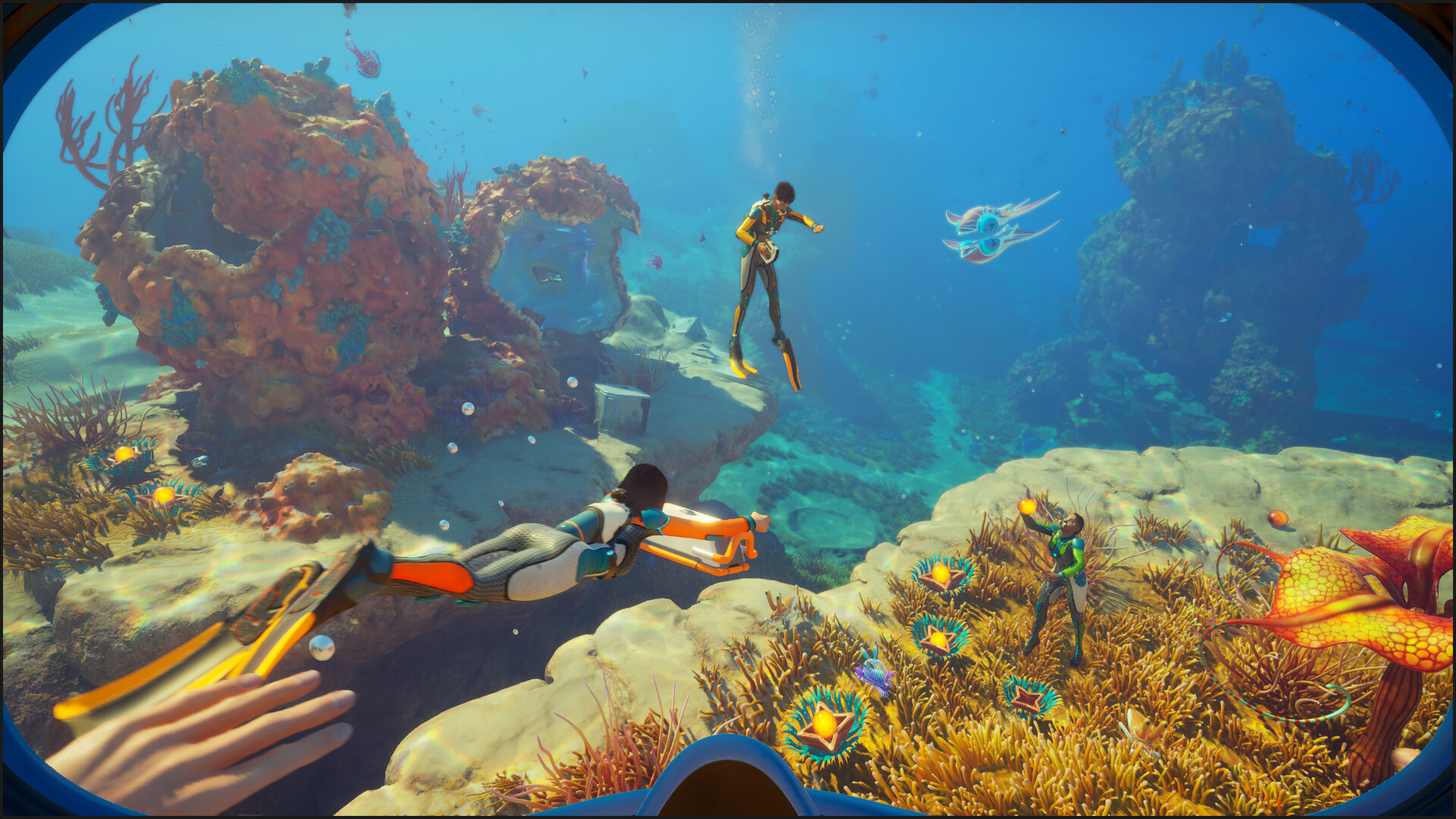
Subnautica 2 co-op guide overview
Subnautica 2 supports online co-op for up to four players, and good co-op is not four people swimming in different directions. This Subnautica 2 co-op guide focuses on host-save planning, shared technology progress, role assignment, food and water pressure, and safe deep-route coordination.
Co-op makes the game faster because one scan or discovery can help the team. It also makes the game messier because materials, food, water, and route knowledge can vanish into different backpacks. Treat every session as a shared expedition with a short objective.
Host save and session planning
Before starting, decide whose world is being progressed. The host save is the session anchor, so the team should know whether the goal is story progression, base expansion, resource farming, Tadpole work, or testing new routes.
Start each session with three calls:
- Current team objective.
- Missing materials or scans.
- Return point and abort condition.
This avoids a common co-op problem: one player progresses a route while another spends strategic materials on an unrelated craft.
Recommended co-op roles
| Role | Job | Good first task |
|---|---|---|
| Scout | Finds landmarks, hazards, route exits, and safe turn-back points. | Map the path from base to the next signal or biome edge. |
| Scanner | Scans fragments, creatures, plants, and structures without taking unsafe detours. | Unlock shared blueprints and adaptation clues. |
| Gatherer | Runs targeted resource loops for the current recipe. | Bring back Copper, Titanium, Quartz, plant materials, or vehicle bottlenecks. |
| Builder | Handles power, storage, Fabricator flow, and base layout. | Keep team-critical materials visible. |
| Vehicle support | Manages Tadpole routes, parking, repair, and upgrades once available. | Test safe range before deeper trips. |
These are session roles, not permanent jobs. Rotate them when a player learns a biome better or unlocks a tool that changes the route.
Food, water, and shared supplies
Co-op increases survival pressure because more players consume food and water. A group that rushes exploration without a food and water plan will lose time to emergency gathering. Build a visible shared supply area early and treat water, prepared food, batteries, repair supplies, and vehicle parts as team-critical.
Deposit strategic items before personal sorting. If a player keeps key minerals or food ingredients in a private locker, the team may waste a full dive farming something already collected.
Route communication
Use simple landmark language. “Left of the blue vent ridge” is more useful than “over here.” Before entering a dangerous route, say the exit, the objective, and the return rule. If one player finds a predator, thermal hazard, infected growth, or confusing cave branch, the team should know before everyone follows.
The best co-op habit is a short regroup after each major scan, craft, or hazard. Regrouping does not kill exploration; it keeps discoveries useful.
Crafting and tech progress
Shared technology progress means duplicate crafting should be deliberate. The team does not need four of every low-impact item in the opening hour. First cover scanner access, oxygen support, base power, storage, food and water, and the next vehicle or route craft.
Use shared resources to keep strategic materials protected and crafting priorities before spending team bottlenecks.
Deep-route safety routine
Before a deep or distant group route, run a quick safety call. Name the driver or scout, the scanner, the player watching food and water, and the player responsible for calling the return. Then agree on the first regroup point. If one player gets separated, the team should know whether to hold position, return to the Tadpole, or retreat to base.
This matters because co-op confidence can hide individual risk. One player may have oxygen to spare while another is already low, or one player may understand the landmark chain while the others only followed. The route is not stable until every player can describe how to get back.
What to do next
Use roles and sessions for a tighter session structure, shared resources for storage rules, and co-op base planning before turning a group base into the main hub.